 Celebrate with up to 80% off
Pros and cons of AI: What it means for work, life, and society


Artificial intelligence (AI) is no longer a futuristic idea; it’s already changing how people search, work, shop, learn, and communicate. It can speed up everyday tasks, support medical research, improve productivity, and help solve complex problems. At the same time, its rapid growth raises important questions about privacy, misinformation, job disruption, and the role technology should play in daily life.
What is artificial intelligence?
At its most basic level, AI is a field of computer science focused on building machine-based systems that can perform tasks normally associated with human intelligence. These systems can analyze information, recognize patterns, and adjust their outputs based on training or feedback.
This separates AI from many traditional computer programs. A standard program follows predefined rules, while AI systems can process large amounts of data and use what they learn to generate recommendations, responses, or decisions.
Overview of AI technologies
To understand how AI systems work, it helps to look at some of the main technologies behind them.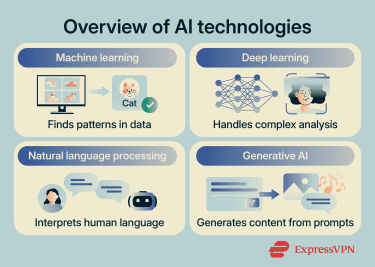
Machine learning and deep learning
Machine learning (ML) is a type of AI that allows computers to learn from data. Instead of relying on a programmer to write rules for every possible scenario, it learns from examples. Over time, it starts to recognize patterns it can apply to new data.
For instance, if an ML system is trained on enough cat photos, it can learn to recognize cat features and determine whether a new photo contains one.
ML is also widely used in cybersecurity, where it can detect patterns in suspicious files or behavior to help identify malware and potential threats.
Deep learning (DL) is a more specialized type of ML. It uses neural networks, which are structures loosely inspired by the human brain, to process information in layers. This allows DL systems to handle more complex tasks, such as self-driving technology and facial recognition, where analysis must account for multiple layers of visual, spatial, or contextual information.
Natural language processing
Natural language processing (NLP) is the technology that helps computers understand, interpret, and generate human language. It’s why a person can type a question into a modern search engine or chatbot and get a more useful, context-aware response.
NLP can also handle the variability of human language, including different ways of phrasing the same question, slang, and context. In voice-based systems, it often works with speech recognition, which converts spoken words into text before NLP helps interpret the meaning.
Generative AI tools
Generative AI is a type of AI that creates new outputs, such as text, images, audio, video, or code, based on patterns learned from training data.
Unlike many non-generative ML systems, which usually classify information or make predictions, generative AI creates new content in response to a prompt.
Common uses include:
| Tool type | What it does | Common examples |
| Text generation | Drafts, summarizes, or rewrites text based on prompts | ChatGPT, Claude, ExpressAI |
| Image and video generation | Creates images, illustrations, animations, or videos from prompts | Midjourney, DALL·E / GPT Image |
| Code generation | Outputs code, suggests fixes, explains logic, creates tests, or automates tasks | GitHub Copilot, Codex, Gemini Code Assist |
Also read: Gemini vs. ChatGPT: Which AI tool should you use?
How people use AI in daily life
AI often works behind the scenes in digital tools people use every day. According to Microsoft’s 2025 global AI adoption report, global adoption of generative AI tools reached about 16% of the world’s population. Here’s how that looks in practice:
- Digital storefronts: Streaming services and online shops use AI to recommend movies, music, shows, and products based on viewing habits, search history, and past purchases.
- Navigation: Car navigators and phone maps use AI-analyzed data to provide the fastest routes based on factors such as traffic, road closures, accidents, and real-time travel conditions.
- Personal assistants: Tools like Siri or Alexa use AI to understand spoken language and carry out commands, such as setting a timer or checking the weather.
- Email services: Spam filters use AI to identify suspicious messages and route many of them away from the inbox.
- Smart home devices: Smart thermostats, security cameras, and lighting systems can use AI to automate settings, detect activity, recognize patterns, or respond to voice commands.
Advantages of AI
AI can help automate routine work, analyze large amounts of data, and support faster information processing and decision-making. For businesses and individuals, this can reduce manual effort and make everyday tools more efficient.
Enhanced efficiency and productivity
AI can process certain types of information faster than humans, especially large datasets, repetitive workflows, and pattern-based tasks.
This helps individuals and organizations save time. For example, AI can summarize long documents, help organize research, or process information at scale, giving users more time for analysis, creativity, and decision-making.
Automating routine tasks
Many roles include repetitive administrative or operational tasks that take time but don’t require much creative input. AI can help automate some of this work, including:
- Data entry: AI can extract information from forms, invoices, or documents and enter it automatically.
- Sorting and filing: AI can categorize emails, photos, or files, making digital spaces easier to organize.
- Scheduling: AI tools can suggest meeting times, set reminders, or organize appointments, reducing manual coordination.
Supporting faster decision-making
AI can help people make faster, more informed decisions by organizing information, spotting patterns, and highlighting useful details.
On an individual level, this can help with everyday decisions such as comparing products, planning travel routes, or summarizing information so it’s easier to understand and act on.
In a business setting, AI can help companies analyze large datasets and respond more quickly to changing demand. For example, Walmart uses AI-powered inventory systems and predictive analytics to help place products across stores, distribution centers, and fulfillment centers.
Enabling 24/7 operational capacity
AI tools can be available around the clock, making them useful for customer support and quick information requests. According to Zendesk research, around 51% of customers say they prefer interacting with bots over humans when they want immediate service.
This supports 24/7 operational capacity by allowing organizations to handle basic requests at any time. It can also help individuals get quick support, such as troubleshooting a device issue, finding information, or getting a simple explanation without waiting for human support to become available.
Reduced human error
AI systems don’t get tired or distracted in the same way humans do, which makes them useful for tasks that require consistency, especially when they’re properly configured and monitored. At home, this can help reduce small everyday mistakes, such as double-booked appointments, missed details in a plan, or overlooked information when comparing prices.
At work, it can support physical quality checks. For example, Ford uses AI-powered vision systems in factories to inspect parts and assembly work. These systems can detect hard-to-spot issues, such as small misalignments or incorrectly installed parts, in real time, helping support quality checks before vehicles leave the factory.
Improved accessibility
AI can improve accessibility by converting information into formats that are easier for people with different needs to perceive, understand, and use.
One major area is communication. AI-powered speech-to-text tools can generate live captions for videos, meetings, and conversations, helping people who are deaf or hard of hearing follow information in real time. Text-to-speech tools can also read written content aloud, supporting blind people, people with low vision, or people with reading difficulties.
AI can also support navigation and daily tasks. Apps like Microsoft's Seeing AI can identify objects, read text, and describe nearby surroundings using a phone's camera, helping blind or partially sighted people better understand the spaces around them.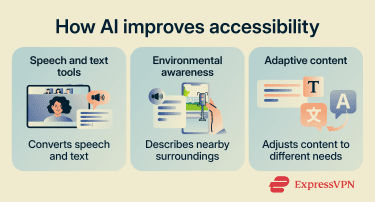
Supporting healthcare and medical research
One of the most important areas for AI is medicine. AI systems can help analyze large amounts of medical data, such as scans, test results, and patient records, to support healthcare professionals and clinical workflows.
However, when AI tools process patient records or other protected health information, they must be implemented with appropriate safeguards. In the U.S., Health Insurance Portability and Accountability Act (HIPAA) compliance depends on how the tool, vendor, data flows, and underlying infrastructure are configured, including whether required Business Associate Agreements are in place.
Outside the U.S., healthcare AI may also be subject to local health privacy, data protection, clinical safety, and medical device regulations.
Note: This section is for general educational purposes only and is not medical, legal, or compliance advice.
Predictive analytics in patient care
According to research in healthcare, AI can support predictive analytics by analyzing a patient’s medical history, test results, and current vital signs to help healthcare professionals assess potential health risks. It may help surface patterns that healthcare professionals can consider when assessing risks such as infection, patient deterioration, complications, or disease progression, depending on the system, data quality, and clinical context.
This kind of early warning can help healthcare teams review cases sooner, monitor patients more closely, and make more informed decisions about care.
AI is also being used to help hospitals manage patient flow more efficiently. In England, an accident and emergency (A&E) demand forecasting tool helps the National Health Service (NHS) trusts predict emergency care demand, anticipate potential surges, and plan staffing, resources, and bed capacity more effectively.
Advancements in medical research, science, and innovation
Developing a new drug has traditionally taken many years and significant financial investment due to extensive lab testing and trial-and-error processes. AI is helping speed up parts of this process by analyzing large biological and chemical datasets, screening molecule libraries, predicting compound properties, and helping researchers prioritize promising candidates earlier in development.
This same approach is also driving breakthroughs in other areas of science. In late 2025, researchers used AI-guided enzyme discovery to identify an enzyme that enabled about 98.6% breakdown of polyurethane foam within hours under tested conditions.
Enhanced safety and security
AI can support safety and security by helping systems detect risks earlier, identify unusual patterns, and alert people more quickly. It’s commonly used to support:
- Physical security: AI-powered surveillance systems can analyze live video to detect defined events, such as someone entering a restricted area. These alerts can help security teams investigate faster.
- Cybersecurity: AI can monitor network activity and flag behavior that differs from normal use, such as repeated failed login attempts or unusual data transfers. These patterns may indicate threats like account compromise or malware.
- Incident response: AI can use data from sensors, cameras, or machines to spot early warning signs of hazards, such as unsafe movement near equipment, poor air quality, equipment faults, or abnormal machine behavior. This can help staff respond before a situation escalates.
Disadvantages of AI
While AI brings many benefits, it also introduces important disadvantages and challenges. Because many AI systems depend on large amounts of data and complex infrastructure, they can create new vulnerabilities around security, privacy, and control over personal information.
Job displacement issues
AI can create new roles and opportunities, but it can also change job demand, reshape existing roles, or reduce the need for certain types of work.
These changes are especially likely to affect work that involves large amounts of digital information, routine analysis, administrative processing, or repeatable content production, though AI can also affect physical roles when combined with robotics, sensors, or computer vision. This includes parts of knowledge work, such as data analysis, reporting, research, and other information-heavy tasks.
Creative and production-focused industries are also changing. In graphic design and advertising, for example, AI tools can generate visuals, draft marketing copy, and quickly produce campaign variations.
In video game development, AI can support technical tasks such as testing, debugging, and generating placeholder assets. In law, AI tools can assist with document review, summarization, and legal research, but outputs still require professional review.
However, AI still requires human oversight. These systems can misinterpret context, produce incorrect results, or present plausible but inaccurate information. As a result, human judgment and accountability remain central to how AI is used in practice.
Also read: How to protect your creative work from AI training.
Privacy and data security
Privacy is a major concern around AI because many systems are trained, tested, or improved using large amounts of data. When that data includes personal information, organizations need clear rules for how it is collected, used, shared, secured, and deleted.
Privacy laws are also evolving as AI becomes more widely used. In the U.K., for example, the Data Use and Access Act (DUAA) 2025 updates parts of the data protection framework, with key privacy and data protection provisions coming into force in stages. This makes it important for organizations to review how AI tools handle personal data and whether their data practices meet current legal requirements.
Not all AI platforms handle user data in the same way. For example, ExpressVPN's ExpressAI provides access to six premium AI models, including Google's Gemma 4 31B, while processing interactions inside secure enclaves that are cryptographically isolated from ExpressVPN, cloud providers, and model operators. That means your inputs and the model’s outputs can’t be accessed outside the enclave and aren’t used for model training. Privacy features like these can be an important consideration when evaluating AI tools that may process sensitive information.
Also read: Is ChatGPT safe? Risks, privacy, and how to use it safely.
How AI uses personal data
AI systems may process different types of data to recognize patterns, personalize services, generate content, or support features such as recommendations and image analysis. Depending on the tool and its configuration, that data may include personally identifiable information (PII), which refers to information that can identify, distinguish, or be linked to a specific person, such as a name, email address, phone number, or home address.
This leads to a few major privacy risks:
- User tracking and profiling: AI systems can analyze online behavior to build detailed profiles about individuals, including their interests, routines, shopping habits, and preferences.
- Unexpected data sharing: Depending on the service’s terms, settings, and integrations, personal information collected for one purpose may be used in ways people may not expect.
- Facial recognition considerations: Facial recognition can support useful features such as identity verification and image analysis, but it may raise privacy concerns when used in public spaces or without clear safeguards.
Once personal information is included in a training dataset, removing its influence from a trained model can be difficult, depending on how the model was built and how the data was used. Even if the original data is deleted, the model may still reflect patterns learned during training.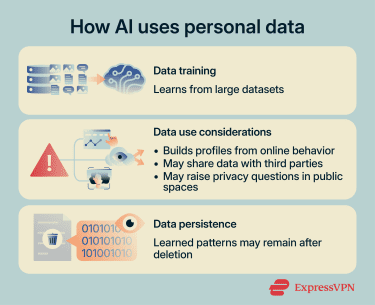
The risks of data breaches
When a company collects or stores large amounts of personal information for AI training, testing, fine-tuning, or service improvement, that data needs strong access controls, retention limits, and security safeguards. Without them, large datasets can become high-value targets for cybercriminals. If the data is exposed in a breach, the impact can be serious because multiple types of personal and behavioral information may be involved.
Also read: DeepSeek vs. ChatGPT: Which AI tool protects your data better?
Bias and discrimination
AI systems don’t have their own opinions, but they can reflect patterns in the data used to train them, in their design, and in the environments where they are deployed. If those inputs or processes contain human or systemic bias, the system may reproduce or amplify those patterns in its outputs.
This can create issues in areas such as:
- Hiring chances: Some AI systems used in recruitment have shown bias in candidate evaluations, sometimes scoring applicants differently based on resume wording, demographic cues, or disability-related information.
- Loan approvals: AI used in lending can reflect historical patterns tied to income, geography, or access to credit. This may lead to unfair outcomes if the system relies on patterns that disadvantage certain groups.
- Content moderation bias: AI systems used to flag harmful content can sometimes over-censor language from specific dialects or cultural contexts while missing similar content expressed in other ways.
- Criminal justice: Algorithmic tools used in policing, bail, sentencing, or parole decisions have raised concerns about biased outcomes, especially when they rely on historical criminal justice data that may reflect unequal enforcement patterns.
- Stereotyping: Text-to-image systems can reinforce stereotypes by overrepresenting certain genders in occupational images, and recent research suggests that even gender-neutral or inclusive prompts may not fully prevent these patterns.
To reduce these risks, companies should review training data, test model outputs before deployment, and monitor systems after release. This includes checking for imbalances, assessing performance across groups, documenting limitations, and regularly auditing systems so they don’t reinforce discriminatory outcomes.
Misinformation from AI
Another big concern about AI is that it can generate convincing yet false information, sometimes presenting incorrect or entirely made-up content in a natural-sounding way. This is often called an AI hallucination.
A related issue is deepfakes: AI-generated or AI-edited videos, images, or audio that make it appear as though someone said or did something they didn’t. These can be highly realistic, especially when they replicate real voices or facial expressions.
To reduce misuse, some companies and standards bodies are developing safeguards such as:
- Digital watermarking: Some AI tools embed invisible markers in AI-generated content so they can be identified later. For example, Google’s SynthID adds imperceptible signals to AI-generated content that are designed to remain detectable after some common edits or compression.
- Content credentials: Standards such as the Coalition for Content Provenance and Authenticity (C2PA) can record information about how a file was created or edited, helping show whether it came from a camera, software, or an AI system.
- Deepfake detection: Some tools analyze visual or audio signals to identify signs that content may have been generated or edited by AI, though detection can be less reliable when content is compressed, altered, or created with newer techniques.
- Safety filters: Some AI tools include restrictions designed to reduce harmful requests, such as attempts to impersonate real people or create deceptive content involving them.
Also read: How to spot a deepfake video.
High implementation costs
While AI can reduce costs over time, building or deploying advanced AI systems can require a high upfront investment. Training frontier AI models often requires significant spending on compute alone, largely due to the need for specialized GPUs and large-scale data centers.
Stanford’s 2024 AI Index estimated that GPT-4 used about $78 million worth of compute to train, while Google’s Gemini Ultra used about $191 million worth of compute. Costs can vary widely depending on model size, infrastructure, training methods, and whether an organization builds a model from scratch or uses an existing AI service.
Environmental concerns
As AI tools become more widely used, demand for data center capacity, computing power, and storage is increasing. This creates growing environmental concerns. Data centers consume large amounts of electricity and generate significant heat, which increases cooling demand. Some facilities use water-based cooling systems to help prevent equipment from overheating.
As AI adoption continues to increase, so does its impact on infrastructure and natural resources. In 2024, data centers accounted for roughly 1.5% of global electricity consumption, or about 415 TWh. The International Energy Agency (IEA) projects that data center electricity consumption could more than double by 2030, driven in part by AI growth. Their growing energy and cooling demands can place additional strain on power grids, water supplies, and cooling infrastructure. Hardware upgrades can also contribute to electronic waste.
Decline of human creativity
As more people use AI to write stories, create images, or generate creative work, some artists and writers worry that creative output could start to feel less original. Because AI systems generate content based on patterns in existing material, they may reproduce familiar styles, structures, or ideas.
At the same time, AI is changing how some creative work is done. Routine or formula-based content may become easier to automate, potentially reducing demand for some production tasks or changing how certain creative roles are performed. However, work shaped by personal experience, emotion, cultural context, and a distinct point of view remains difficult for AI to replicate meaningfully.
Concerns about online authenticity
One concern linked to the rapid growth of AI is the “dead internet theory,” which suggests that a large share of online content could eventually be generated, amplified, or shaped by AI rather than created directly by people.
For example, a 2025 analysis by Originality.ai estimated that 17.31% of Google’s top 20 search results contained AI-generated content. The dead internet theory remains speculative, and AI-content detection estimates can vary by method, but findings like this have contributed to wider discussions about online authenticity and the growing amount of automated content on the web.
Ethical considerations in AI
As AI becomes more widely used in everyday life, questions about how it should be developed and used responsibly have become increasingly important.
Transparency and accountability
For AI to be developed and used responsibly, its decisions should not function like a black box, where outputs are produced without any meaningful explanation or accountability. This is addressed through the following key principles:
- Explainability: AI systems should be designed, tested, and documented so people can understand the main factors behind important outputs or decisions. This isn’t as simple as asking an AI to explain itself after the fact, since it may produce a plausible but inaccurate explanation.
- Traceability: There should be records showing what data, model, process, or human decision contributed to an AI output, making it easier to audit decisions and assign responsibility if something goes wrong.
- Interpretability: Some AI systems are designed so humans can more easily understand how outputs are produced, rather than operating in ways that are highly opaque or difficult to evaluate.
Human oversight in AI decisions
While AI is strong at identifying patterns and processing information quickly, it lacks human judgment, context, and ethical understanding, which are essential in high-stakes situations. As such, high-stakes AI workflows should include appropriate human oversight:
- Human-in-the-loop: A person actively reviews, approves, corrects, or contributes to important AI actions before they take effect.
- Human-on-the-loop: The system runs independently, but a human monitors it and can intervene when needed.
- Human-in-command: Humans decide the overall goals, rules, and boundaries, and deployment conditions for the AI.
Responsible AI development
Responsible AI development means building safety, fairness, privacy, and accountability into the software from the start and continuing to monitor it after release.
- Bias testing: Before an AI is released, developers should test it for harmful bias. This means checking if the system treats people differently based on race, gender, or age. Fairness should be evaluated with evidence before launch and monitored after deployment.
- Safeguards against misuse: Developers must build guardrails to reduce the risk of misuse. This includes limits designed to reduce the generation of dangerous content or attempts to impersonate real people.
- Privacy by design: Privacy and safety principles should be built into the system from the start, helping protect personal data throughout the AI lifecycle.
FAQ
Can AI replace human thinking?
How can people use AI safely?
What skills are useful in an AI-driven world?
Can AI-generated content be trusted?
How can businesses reduce AI risks?
What should students know about using AI?
Will AI create new jobs?
How can AI be regulated responsibly?