Expressvpn Glossary
Data diode
What is a data diode?
A data diode is a network security device that sits between two networks and allows data to travel in only one direction. The one-way flow is enforced by hardware, so traffic cannot return across the connection, and the receiving network cannot initiate communication with the source.
It's commonly placed between networks with different trust or security levels, such as a protected operational environment and a less-trusted external network. Systems can export selected information while remaining isolated from inbound network access. This provides stronger assurance of one-way separation than controls that rely only on software or configuration.
How does a data diode work?
A data diode separates transmission and reception at the interface level. For example, the connection between the two networks may use a physical design that allows data to pass in one direction only, preventing any return traffic.
Because most network protocols expect two-way communication, deployments typically add proxy, replication, or protocol-break software to recreate the transmitted data or service on the receiving network.
In operation, the device might forward logs, alerts, and telemetry to monitoring systems outside the protected environment, allowing analysis without exposing internal systems to inbound connections.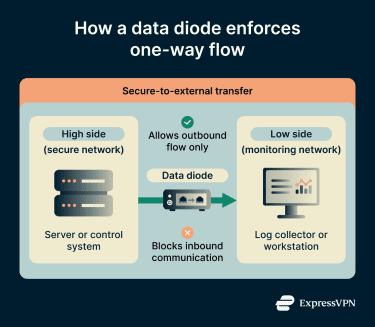
Types of hardware data diode deployments
There are several ways unidirectional gateway products can be implemented or deployed. Common variations include:
- Hardware-enforced unidirectional links: Devices that physically restrict communication to a single direction.
- Single-purpose vs. multi-protocol platforms: Platforms designed for one transfer function or for multiple replicated data services and protocols.
- Ruggedized industrial vs. enterprise models: Models built either for harsh operational environments or standard information technology and data center deployments.
- One-to-one vs. one-to-many designs: Architectures that deliver data to a single receiver or distribute it to multiple collectors.
Note: Some vendors use terms such as logical or software-based unidirectional gateways to describe systems that emulate one-way transfer via software controls. These are related to data diodes, but they don't offer the same hardware-enforced assurance as a true data diode.
Why is a data diode important?
Traditional perimeter defenses rely on filtering decisions. A firewall examines packets and allows or blocks them according to rules. Misconfiguration, vulnerabilities, or unexpected protocol behavior can still create a path into sensitive environments.
A data diode greatly reduces exposure by eliminating the inbound path across that connection. Malware cannot establish a remote session via the link, and compromised external systems cannot use that path to access the protected network. Additional security controls are still needed elsewhere in the environment.
Implementing this type of control can help organizations support regulatory, operational, or architectural requirements for segmentation and one-way data transfer while strengthening overall security.
Where is it used?
Data diodes are deployed where systems must share information but remain unreachable from external networks over that connection.
They are common in industrial control systems and operational technology environments such as energy, utilities, and manufacturing. Equipment can send telemetry and status data to monitoring platforms while preventing remote commands from entering the control network through the same link.
Government, military, and other high-security environments use the same approach to move selected data to lower-classification environments for analysis.
Data diodes can also be used to export logs, alerts, and similar monitoring data from sensitive networks to centralized or isolated analysis systems for monitoring and incident response.
Benefits and limitations
Like most high-assurance security controls, data diodes change how connected systems operate.
Key benefits are:
- Hardware-enforced isolation: With physical data diodes, the communication direction is determined by physical components rather than configuration, reducing reliance on software controls.
- Safe monitoring export: Logs, alarms, and telemetry are analyzed on external systems without creating inbound network access across the diode link.
- Reduced exposure across the boundary: External attackers and internal misuse have fewer available paths to access or move data across that connection. Additional controls are still needed elsewhere in the environment.
Main limitations are:
- Lack of interactive connectivity: Remote administration, authentication exchanges, and many modern applications require bidirectional communication and cannot function over a unidirectional link.
- Integration complexity: Deployments often require proxy, replication, or protocol-break software, along with logging and monitoring adjustments, to preserve visibility while keeping the boundary one-way.
Further reading
- What is the Stuxnet virus and why does it matter?
- What is IIoT and why its security matters more than ever
- The 7 pillars of zero-trust security
- What is a subnet: A complete guide
- What is a firewall, and how does it work?